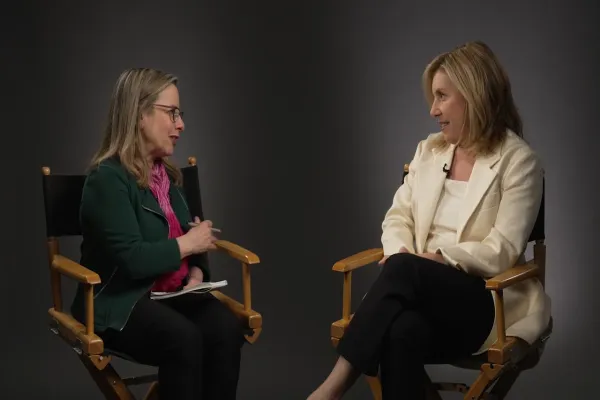

Keith McDonagh and his colleagues at MassMutual Life Insurance Company (MassMutual) are in the business of providing financial and risk management solutions for institutions – and, as you might imagine, that business has seen customers’ needs increase in a wildly unpredictable 2020. McDonagh is the Head of MassMutual’s Institutional Solutions businesses, which involve the design and delivery of solutions for pension liabilities, retirement solutions, financial returns, protection needs, and increased employee benefit costs. The solutions include pension risk transfer, bank-owned life insurance and corporate-owned life insurance (BOLI and COLI), stable value investments, mutual fund investments, funding agreement backed notes, and guaranteed interest contracts. II recently spoke with McDonagh about his observations while interacting with investors in this tumultuous year, and how the lessons learned can be applied moving forward.
What are you hearing in terms of the challenges that your institutional clients have faced and continue to face as a result of the pandemic, economic stress, and geopolitical uncertainty?
Keith McDonagh: When we started the year, no one would have been able to predict the course it would take. As the year progressed, if you asked the same people about the future, their perspective would change with each passing month. There has been uncertainty and volatility not only with the pandemic, but in terms of interest rates, equity markets, employment, the economy, GDP, trade policies and/or competition between nations, the upcoming general election – it’s an almost endless list, with uncertain, volatile, and unpredictable being its three most common adjectives.
In other words, a time when investors are asking themselves a lot more questions than they typically would.
McDonagh: Right, and that’s another long list: How do I manage the environment to achieve my goals? How can I be better prepared? How can I be more flexible? How can I check and adjust, or pivot, as needed to meet my expectations? How do I make sure I have enough liquidity to meet what could be changes in consumer demand or consumer behavior? And enough liquidity to take advantage of opportunities that may occur due to this volatility? How can I achieve adequate yield in a low interest rate environment? There was a time this year when credit spreads widened measurably and then came back in, and equity markets fell and came back, so how can I achieve my goals within my stated investment philosophy?
At MassMutual, we like to say, “You can’t predict, you can prepare.” And we also like to say, “Think long term, not just short term.” What we mean when we say either is that asset owners and managers have to excel at managing risk – whether those risks are related to changes in valuations, assets and liabilities, or benefit funding – and the volatility that risk could create on their income statement and balance sheet, or at a time when they require funding to meet a need. It’s a matter of having the right arrows in the quiver to match assets and liabilities within the risk tolerances and strategic goals that have been set.

Have you seen an uptick in the number of institutions reaching out to you with a sense of urgency?
McDonagh: The dynamics have been interesting in that regard. In the first month of the pandemic, all the focus was short term. That’s where we saw the huge focus on liquidity, and as we all recall, the bond markets seized for a couple weeks as we got into late March, early April. It was also a period where those companies who may have been contemplating large transactions hit the pause button while they surveyed the environment, because they didn’t know what conditions were coming and what they might need – and it was difficult to focus on all the details of a large transaction with everything that was going on.
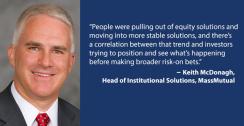
The second dynamic we saw in that timeframe was a bit of a flight to certainty. For example, the demand for solutions like stable value in those first couple months increased dramatically. People were pulling out of equity solutions and moving into more stable solutions, and there’s a correlation between that trend and investors trying to position and see what’s happening before making broader risk-on bets.
Was there increased decision making in terms of some of the strategies that might apply to pensions? Maybe more conversations about LDI?
McDonagh: There were, and I’ll frame this answer in a six-month window starting in March, because I think it’s quite insightful. In the early days, those sponsors who had engaged LDI going into the crisis were very happy, because their funded status was more stable. Those who had only been dabbling in it, or thought about it but hadn’t executed, suddenly showed a lot more interest in what LDI was about as they saw the impact of unfolding events. So, we were engaged in conversations about how LDI works, clearly, but also about some of the investment solutions, say, in a long-term bond fund, that can be used in an LDI context.
There was a second thing we saw early in the crisis. The pension risk transfer market has been growing each of the past 10 years or so, and the pipeline was quite healthy in the first quarter. In the early months of the crisis, plans that were looking at retiree carve-out transactions paused given the economic conditions. If you look at market data for the second quarter, you’ll see that activity slowed, and the transactions that were executed tended to be plan terminations, because they were already scheduled.
the companies wanted to hold cash. Second, management bandwidth – they were worried about other things.
A third dynamic is that several of those transactions that had paused came back to market in the latter months of the year. So, as the equity markets rebounded, for example, pensions plans that still have heavy equity allocations saw their funding status improved. That’s an example, but as time passed and economic conditions stabilized, management could go back to focusing on some of the risk management plans they had in place. Not back to normal, but a significant rebound from what you would have seen in, say, April, May, June, and July.
That seems to speak to a realization that they really needed to execute on things they’d been planning – a return to some sense of normalcy.<
McDonagh: It’s that feeling of “I should have paid more attention to these long-term planning considerations when times were good, so now I’m going to put it on my project plan as one of the things I need to focus on going forward.”
People talk about business continuity planning, but what we’re talking about is almost investment and financial continuity planning – you need to have a plan for how you’re going to continue on the path to achieving your long-term goals, even when things are disrupted.<
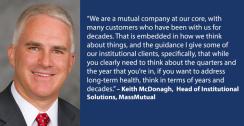
McDonagh: We are a mutual company at our core, with many customers who have been with us for decades. That is embedded in how we think about things, and the view I give our institutional clients, specifically, is that while you clearly need to think about the quarters and the year that you’re in, if you want to address long-term health, think in terms of years and decades. As many of us learned in business school, a successful business positions itself for success through various economic cycles and environments. Undoubtedly, there will be expansion years and contraction years, and you should position your business strategy and the products and services you offer accordingly, along with how you interact with customers and changes in consumer behavior. Asset owners should be applying those same principles to investment management and risk management, thinking both long term and short term. If you don’t, you could get imbalanced.
Learn more about how opportunity favors the prepared.