
Nobel Laureate, Bill Sharpe, called decumulation in retirement “the nastiest, hardest problem in finance.” 2 And research has shown it’s certainly a subject that keeps a lot of people up at night. Massive progress has been made in recent years regarding defined contribution (DC) plan participation, and target date funds (TDFs) have proven to be a reliable go-to for investors and plan sponsors. The overall success of TDFs has created what Robert Crothers, Director, Head of Product for BlackRock’s Retirement Group, calls an “ecosystem” in which to best develop solutions for retirement income. For this conversation with II on what is perhaps currently the most innovative solve for retirement income, Crothers, who oversees all product management and development functions for BlackRock’s retirement products, was joined by Nick Nefouse, Managing Director, Co-Head of BlackRock’s LifePath® target date fund franchise, and Head of Investment Strategy for BlackRock’s Retirement Group.
Why do so many American workers still have serious concerns about whether they’ll have enough money to retire – and specifically about income during retirement?
Robert Crothers: It’s a combination of things. First, just the sheer number of people retiring. There is some data that suggests as many as 10,000 baby boomers reach retirement age every day.3 The size of that generation has put more focus on retirement preparedness. And, of course, far fewer people have access to defined benefit (DB) plans today than was the case even 10 years ago. Essentially, we moved from a market where the company carried you and sent you a check in the mail or made a direct deposit on a regular basis, to a market where the retirement burden has shifted largely to the individual. That, in a nutshell, has produced a model where you give retirees a lump sum check, and say, “Good luck!” – with limited or no guidance, and limited or no financial wellness or financial literacy education along the way.
Where are we on the curve of American workers realizing and acting on the idea that retirement saving and income is really up to them?
Nick Nefouse: Access is everything. About half of the country has access to a 401(k) plan. That half of the country seems to be well on the path to retirement, or at least has a good starting point on that path. Half of the country doesn’t have a 401(k), and not always for bad reasons. Many small businesses and startups likely won’t have a plan in place, some workers are transient, and so forth. People who have access to 401(k) plans tend to do a better job saving because the features of plans have evolved to allow them to save. [Nobel Prize-winning economist Richard] Thaler coined what he calls libertarian paternalism, and the idea, to paraphrase, is that you have a lot of choices, but if you choose nothing, “we’re” going to take care of you. In the context of this discussion, the “we” are plan sponsors and the features of a DC plan, such as auto-enrollment, auto-escalation, and target date funds. When you combine those things, you can get better savings rates – but DC plans aren’t everywhere yet.
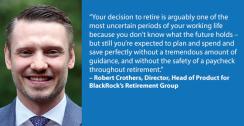
Crothers: If you think about the transition from accumulation in your working years to decumulation in retirement, it’s full of uncertainty and questions around things that aren’t knowable – how long will you live? What will your health-related spending needs be later in life? This problem isn’t just potentially mathematically difficult, but also difficult because there are behavioral and personal elements involved. Your decision to retire is arguably one of the most uncertain periods of your working life because you don’t know what the future holds – but still you’re expected to plan and spend and save perfectly without a tremendous amount of guidance, and without the safety of a paycheck throughout retirement.

What interesting recent insights have you heard from plan sponsors about participant behavior?
Nefouse: A common thread is that the investment industry and plan sponsors have done a good job of helping people accumulate wealth when they have access to 401(k) plans. There’s general agreement that 401(k)s with target date funds tend to have low-cost, professionally managed and diversified portfolios. And there’s agreement that other things are good – auto-enrollment, auto-escalation, and those get your dollar cost averaging going. All of those things are really good. But for investors, when retirement arrives there is still uncertainty, and it manifests itself in their actions. For example, people will anchor to whatever their account balance is at retirement. We looked at a cohort of people who were 18 years into retirement and still sitting on 80% of their wealth. Average life expectancy at 65 is about 19 years, so what we’re seeing is some people still have 80% of their wealth 18 years after retirement. They anchor to a number and just spend their capital gains and Social Security. The effect of this is they lead different lifestyles compared to what it could be like if they spent to their full potential. Plan sponsors are seeing this, particularly more paternalistic ones, and trying to offer ways to help.
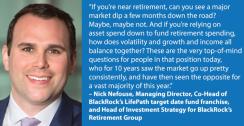
Further, an economic environment like the one we’re currently in – market volatility, uncertainty around what’s going on economically – can take an economic toll on someone who is at or near retirement. If you have 30 or 40 years of your working life to ride out volatility, that’s fine. But if you’re near retirement, can you see a major market dip a few months down the road? Maybe, maybe not. And if you’re relying on asset spend down to fund retirement spending, how does volatility and growth and income all balance together? These are very top-of-mind questions for people in that position today, who for 10 years saw the market go up pretty consistently, but have seen the opposite for a vast majority of this year.
What is needed to help address the challenges of generating retirement income?
Crothers: A general goal of enhancing retirement income solutions is to create simple access to guaranteed income. In a way, it’s almost like bringing back a DB-like experience for a participant cohort that hasn’t necessarily had access to a DB plan and likely won’t in the future. We find that plan sponsors are looking for better retirement income solutions to help improve certainty that participants can retire with dignity, and participants are looking for certainty around what they’re going to get – a guaranteed income stream to go along with Social Security and any other assets they might have to spend.
As a significant player in DC, we know that people need help with decumulation, and that simply having a large menu to choose from, or a portfolio of funds, doesn’t lead to an obvious amount of income in retirement. Instead, as an industry we need to address simplicity by solving for convenience, choice, and cost.
How do you approach educating participants about retirement income?
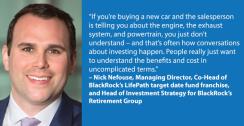
Nefouse: Simplicity. If you’re buying a new car and the salesperson is telling you about the engine, the exhaust system, and powertrain, you may not understand – and that’s often how conversations about investing happen. People really just want to understand the benefits and cost in uncomplicated terms.
We also see good engagement when we talk about personal income in retirement as opposed to an account balance. People know they have a balance, but they don’t know if $200,000 is a lot or a little in retirement, or if $1 million is a lot or a little. They likely become interested when you educate them on how much money they may actually need in retirement.