

Two decades ago, 19% of defined contribution assets were invested in company stock, effectively “doubling down” on the financial risk participants already had in their firm’s financial future. While company stock is not as common as it once was on DC menus, it still has a major presence: According to the Employee Benefit Research Institute (EBRI), 49% of plans with more than 5,000 participants offer company stock, with average participation allocation ranging between 10–20%. In other words, company stock in DC plans is not not an issue.
The appeal of company stock in DC plans to relevant companies and plan sponsors is understandable – employees might feel more engaged and committed to the business knowing they have extra skin in the game. But it’s also a risky pursuit, especially when you know this: According to EBRI, 5% of DC participants in plans with company stock have virtually all their savings invested in this option. That is an eye-opening statistic for two reasons: concentrating investment risk in any single stock runs contrary to accepted wisdom on diversification; and, employees who rely on company stock for retirement savings are essentially doubling down on their dependence upon their employer’s financial health.
There are many misconceptions around employees holding stock in their DC plans. Here are five common myths about company stock that DC plan sponsors should know about. The next chapter of this report will offer some suggestions on how plan sponsors can manage their company stock risk.
Myth #1: It’s mostly executives and higher income participants who hold company stock in DC plans.
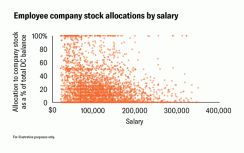
The assumption that company stock is concentrated among executives and other higher salary employees makes sense. Very often they are required to hold it, and as more sophisticated investors, they can be trusted to diversify outside their workplace plan. The data tells a different story. When BlackRock conducts plan design analysis using participant level data, it has consistently found that it’s the lower income participants with the largest concentrations in company stock. Why? Inexperienced investors may choose the company they believe they know, a fallacy known as familiarity bias (a close relative of home country bias). Whatever the reason, it appears that the more financially vulnerable participants are exposed to excessive undiversified risk. Clearly, this could be a fiduciary concern.
Myth #2: The company benefits from increased engagement and productivity.

One of the justifications for including company stock on the investment menu is the belief that it will help align employer and employee interest, creating greater employee engagement and productivity. Academic studies of both the monetary and non-monetary benefits have found mixed evidence at best. For instance: 59% of surveyed participants stated that owning company stock did not make them feel better or worse about their company, and 32% stated company ownership did make them feel better.1 Interestingly, in the same study, researchers found that these employees were predominately working for companies whose stock had performed very well, suggesting that picking a winner was the prime driver of goodwill.
Evidence on whether employee stock ownership positively affects company performance by encouraging increased productivity is also inconclusive.2 Keep in mind that company stock is typically offered by large plans with many employees, so a rank-and-file employee effort is likely to have an extremely small impact on overall firm performance, giving him or her little incentive to work harder. Given the research, the benefit to the company is either non-existent or negligible. It’s hard to make a case that it’s enough to justify the risk.
Myth #3: It’s paternalistic to assume participants don’t understand the risk.
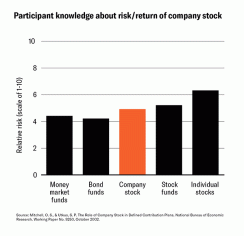
While most participants are not sophisticated investors and may lack basic investment terminology, many have absorbed enough to have a sense of risk. For example, surveys find that participants correctly rate a single stock investment as riskier than an equity fund. So far, so good.
Unfortunately, surveys also find that participants rank their employer stock as less risky than a diversified equity fund. Because they feel they know their firm and its products and services, they may feel they have some level of control over its stock performance. On the other hand, they may never have heard of many of the companies that make up the diversified portfolio and associate the unknown with risk. Even sophisticated investors suffer from discomfort about unknown or less familiar options, allowing it to affect their decisions.
When it comes to potentially less sophisticated investors, such as participants whose investment experience may be limited to their workplace plan, extra caution in describing the risks of holding company stock may be justified.
Myth #4: If the risk were significant, ERISA would prohibit it.
ERISA (Employee Retirement Income Security Act) requires fiduciaries to act with prudence and diversify the plan’s investments to minimize the risk of large losses. Yet ERISA explicitly exempts company stock from the diversification requirement, which paves the way for unsophisticated DC participants to invest their retirement savings in a single stock that is correlated with their labor income. Despite the exemption, plan sponsors have found themselves involved in costly litigation over company stock.
There are many complex and, occasionally, competing reasons why ERISA provisions take the shape they do. But if you look to ERISA for insight regarding the risk of company stock, consider this: the law imposes a 10% limit on employer securities in defined benefit (DB) plans. Therefore, while the most sophisticated investment managers in retirement have guardrails in place, participants selecting their own investments do not.
Myth #5: Everyone learned from past mistakes such as Enron.
Plan sponsor attitudes have shifted regarding company stock. For example, it was once common practice to match participant contributions with company stock, but it would be less common to see the practice today. Nonetheless, the problem persists in many large plans because of participant inertia and the hesitation of plan sponsors to reenroll participants. That leaves it to individual participants to make the choice. Have they learned from the past? There is considerable evidence that the answer is no.
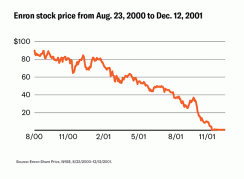
Enron’s collapse in 2001 is likely the most well-known dark chapter in the history of company stock. Over 60% of participants’ DC assets were invested in Enron stock, so when the firm filed for bankruptcy, many lost their retirement savings along with their jobs. In the aftermath, Boston Research Group3 conducted a study in the Houston area (Enron’s headquarters), where it was assumed survey respondents were likely to have first- or second-hand experience of the dangers of investing significant amounts of retirement savings in employer stock. Did it change their appetite for company stock? Despite the well-publicized local retirement catastrophe, the study found that participants were unfazed: they continued to invest in their company stock.
There are few “free lunches” in life, but modern portfolio theory suggests that diversification may be one. It holds that investing in a portfolio of stocks allows us to earn the weighted return of the individual stocks, but with typically less risk than the weighted risk of the individual stocks. If that’s the case, then it isn’t only the outliers like Enron that cause concern. Any single stock portfolio poses diversifiable risk.
There are more misconceptions about company stock that plan sponsors should understand. Learn more about them.
1 Benartzi, S., Thaler, R. H., Utkus, S. P., & Sustein, C. R. The Law and Economics of Company Stock in 401(k) Plans. The Journal of Law and Economics 50, No. 1 (February 2007), pp. 45-79.
2 Mitchell, O. S., & Utkus, S. P. The Role of Company Stock in Defined Contribution Plans. National Bureau of Economic Research, Working Paper No. 9250, October 2002.
3 Boston Research Group. Enron Has Little Effect on 401(k) Participants’ View of Company Stock. April 25, 2002.