

To help meet these growing institutional liquidity needs, BlackRock created and launched its Liquid Policy Portfolio (LPP) strategy in 2011. LPP strategies are designed to reflect the median asset allocation of pensions, foundations, and endowments. An LPP strategy consists of a portfolio of exchange-traded funds (ETFs) and seeks to deliver a typical policy benchmark allocation with exchange-traded flexibility and liquidity.
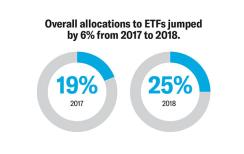
LPP strategies were an early example of BlackRock setting the pace for what would become (and remains) a growing trend of institutional investors using cost-efficient ETFs to help meet liquidity demand. According to 2019 Greenwich Associates research, 81% of asset owners cited liquidity as a primary reason for using ETFs, and overall allocations to ETFs increased to 25% of total assets in 2018, a jump of 6% from one year earlier.
Potential benefits and considerations of LPP strategies
As on off-the-shelf offering, LPP strategies are designed to address the challenges common to many institutional investors, and to deliver a core set of benefits that are underpinned by the traits of ETFs.1
For starters, LPP strategies offer operational efficiency. ETFs offer intra-day liquidity, with the possibility of T+1 settlement.2 In addition, using a liquidity sleeve to help meet cash needs can reduce disruption to actively managed mandates.
They also offer cost and investment efficiency. Compared to holding excess cash, LPP strategies can potentially reduce tracking error relative to policy benchmark.

LPP strategies use median allocations. For pensions, the median allocation data is provided by Pensions & Investments, while Greenwich Associates provides the median allocation for foundations and endowments.
In executing LPP strategies, asset-class exposures are mapped to the most relevant indices and assigned to related iShares ETFs. This mapping is complemented by additional mapping of alternative asset classes (private real estate, for example) to their most relevant index counterparts (in the private real estate example, that could be REITs adjusted for leverage). The result is a combination of iShares ETFs.
LPP strategies may also raise certain considerations related to risks and exposure. LPP strategies hold non-cash vehicles and therefore are more volatile than cash. Also, a client’s long-term investment policy may have a different risk/return profile than the LPP allocations.
1 Capabilities may vary depending on the specific implementation and/or investment vehicle.
2 For redemptions, T+1 settlement is conditioned on the ability to short settle ETF trade orders with brokers. If short settlement is not available, settlement will revert to standard T+2 settlement.