
“There is no business to be done on a dead planet.” – David Ross Brower
Only 15% of the world lives in developed countries, yet these countries represent over 40% of the world’s GDP. However, this is likely to be transformed in the near future. Various estimates predict that by 2030, the middle class will reach 5.6 billion people, which translates into 2 billion people with increased purchasing power – 87% of whom are Asian. India and China combined will represent 66% of the global middle class in just over a decade.1
Most of the emerging countries see the developed markets as an aspiration and understandably want to be part of the growing middle class. At BMO, we consider this a great opportunity. We love talking about the low penetration of various consumer products and long-term secular growth prospects as these markets grow in wealth and size. While the narrative of investing in the emerging markets sounds promising, there is a simple question that investors often forget to ask – what is the negative impact of these positive improvements? We know from the evolution of the developed world that our benefit has come at a cost to the environment. As it stands, we remain the largest environmental offenders from a per capita perspective. Reflecting on the per capita element, the fact that by far the majority of the world’s population resides in the emerging markets and wants a higher standard of living will inevitably worsen the environmental crisis we face.
Get to know the team involved in a remarkable collaboration around responsible investment.
Emerging markets must leverage resources
Emerging markets will require more energy output as they become more power-hungry, leading to more power plants fueled largely by coal given its abundance and low cost of extraction. The inevitable result is larger carbon emissions and air pollution. These consumers will also require more factories, producing short-lived consumer products that will lead to plastic and other types of waste that are likely to end up polluting land and oceans or in our food systems through microplastics. This is just the tip of the iceberg for the environmental damage that is taking place as billions move closer to becoming middle-income citizens.

For us it is clear that the developed world cannot expect the emerging world to curb its middle- class aspirations in exchange for cleaner water and air. A new approach is required, one where economic progress is not solely calculated based on traditional revenue or EBITDA metrics, but also on whether companies are operating in a sustainable2 way to actively minimize their negative impacts, while providing products and services that are improving the quality of life for the masses.
Specifically, for the BMO Responsible Global Emerging Markets strategy, we look for companies that have a positive impact by either solving, or being positioned to benefit from, the sustainability challenges in emerging markets.
China no longer a sleeping giant
In our investment universe, we regularly observe some emerging nations that go two steps forward and one step back in terms of economic development, while others have progressed more steadily — among the latter group is China. China as a nation has done a tremendous job of lifting its large population into the middle class from poverty. China today leads the world in the number of internet users and college graduates and is working to land a person on the moon. It is fair to say China is no longer the sleeping giant portrayed by Napoleon Bonaparte. This success has a cost, though. The ecological environment of this 1.4 billion-strong nation, who today eat three times as much meat as in 1990 and consume five times more dairy than in 1995, is faced with declining farmland, where 20% of what remains is polluted and there is visible air pollution in cities.3 Many other challenges are highlighted regularly in the media.
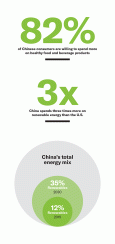
While it is easy to be pessimistic about the future of China with all the negative news that is regularly flagged to us, we remain optimistic that over time China will overcome these challenges. There is a lot of progress that often doesn’t make front-page news. For example, China spends three times more on renewable energy than the U.S. It is also by far the largest investor in this field globally, with renewables expected to reach 35% of China’s energy mix by 2030 – up from 12% just 4 years ago.4 82% of Chinese consumers are willing to spend more on healthy food and beverage products, much higher than the global average of 68%.5To keep the “social contract” between the leadership and the people intact, there is a requirement to change and improve. We are already seeing this and are likely to see more. In other emerging markets, we are seeing countries heavily investing in renewables, banning plastic bags, implementing a tax on sugar – basically taking the social cost from the public and forcing it into the accounts of the corporates. We welcome this and, equally, we demand our companies to prepare for and, where possible, benefit from these challenges.
Learn more about BMO’s Emerging Markets and Responsible Investing capabilities at bmogam.com.
1 https://ec.europa.eu/knowledge4policy/foresight/topic/growing-consumerism_en: “middle class” defined as earning $11 to $110 per day, can expect to live a decent life and have escaped extreme poverty. They are also known as the ‘consumer class,’ the group whose demand powers most economies.
2 Avoidance of the depletion of natural resources in order to maintain an ecological balance.
3 Coal is still around 2/3 of the energy source for China.
4 Source: U.S. Energy Information Administration and https://asia.nikkei.com/Spotlight/Cover-Story/China-s-renewable-energy-surges-after-state-backing
All investments involve risk, including the possible loss of principal. Past performance does not guarantee future performance.
Views and opinions expressed by individual authors do not necessarily represent those of BMO Global Asset Management. The information, opinions estimates or forecasts contained in this document were obtained from sources reasonably believed to be reliable and are subject to change at any time.
This presentation may contain targeted returns and forward-looking statements. “Forward-looking statements,” can be identified by the use of forward-looking terminology such as “may,” “should,” “expect,” “anticipate,” “outlook,” “project,” “estimate,” “intend,” “continue” or “believe” or the negatives thereof, or variations thereon, or other comparable terminology. Investors are cautioned not to place undue reliance on such returns and statements, as actual returns and results could differ materially due to various risks and uncertainties. This material does not constitute investment advice. It does not have regard to the specific investment objectives, financial situation and the particular needs of any specific person who may receive this report. Investors should seek advice regarding the appropriateness of investing in any securities or investment strategies discussed or recommended in this report and should understand that statements regarding future prospects may not be realized. The mention of specific securities or products is for informational purposes only and is not intended as a recommendation to buy, sell or sold any security or product.
BMO Global Asset Management is the brand name for various affiliated entities of BMO Financial Group that provide investment management and trust and custody services. Certain of the products and services offered under the brand name BMO Global Asset Management are designed specifically for various categories of investors in a number of different countries and regions and may not be available to all investors. Products and services are only offered to such investors in those countries and regions in accordance with applicable laws and regulations. BMO Financial Group is a service mark of Bank of Montreal (BMO).
BMO Asset Management Corp. is the investment adviser to the BMO funds. BMO Investment Distributors, LLC is the distributor. Member FINRA/SIPC.
Securities, investment advisory, and insurance products are: NOT A DEPOSIT — NOT FDIC INSURED — NOT BANK GUARANTEED — MAY LOSE VALUE.
© 2019 BMO Financial Corp. (8601029, 6/19